In the increasingly crowded battle for attention in India’s streaming market, JioHotstar is turning to artificial intelligence to help viewers answer a deceptively simple question: What should I watch tonight?
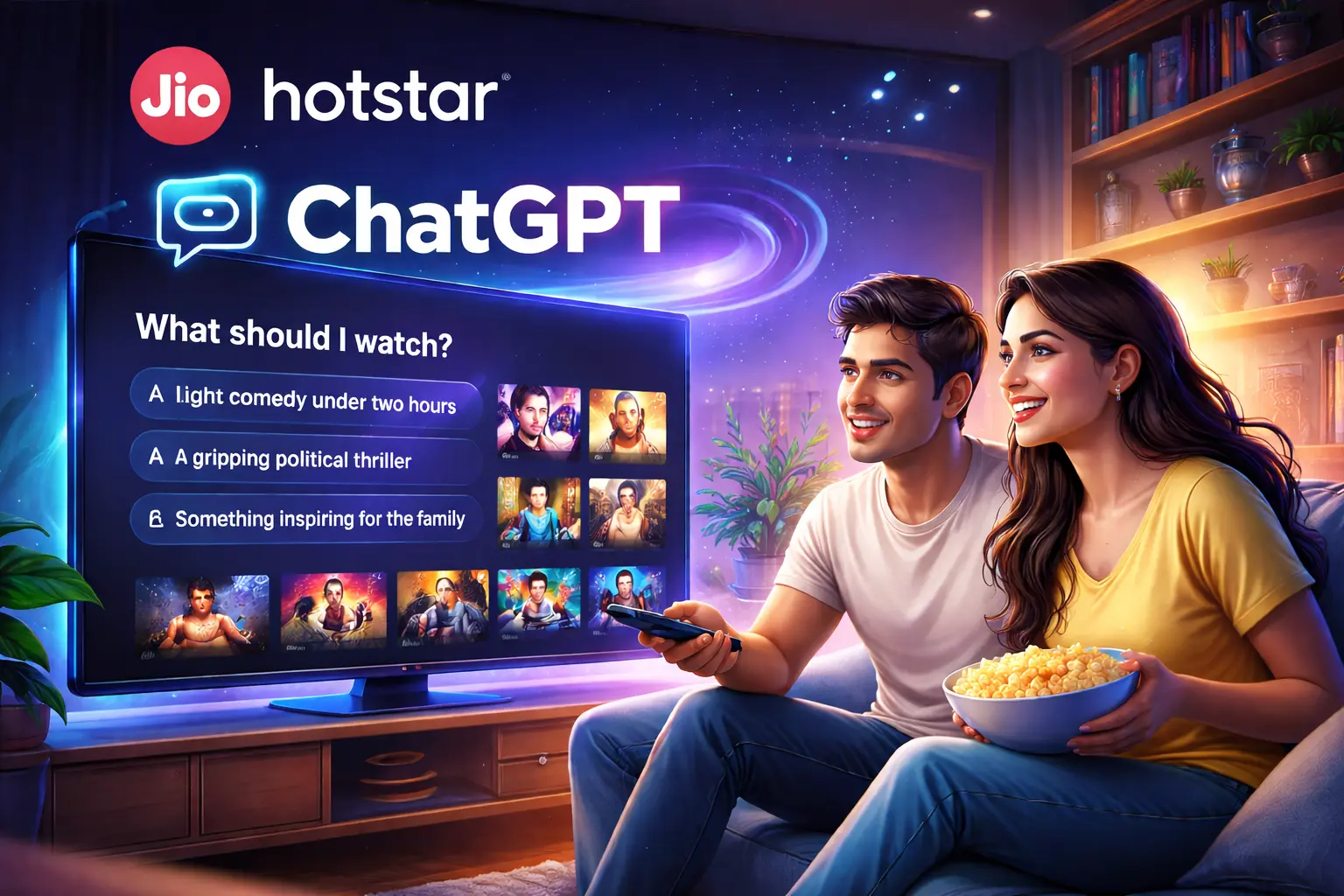
This week, the platform announced a new in-app feature powered by ChatGPT, the conversational AI developed by OpenAI, allowing users to receive personalized recommendations through natural-language prompts. Instead of scrolling endlessly through rows of thumbnails, subscribers can now type or speak queries like “a light comedy under two hours,” “a political thriller based on real events,” or “something inspiring to watch with family,” and receive curated suggestions in seconds.
The move reflects a broader shift in streaming, where discovery — not content — has become the industry’s most urgent challenge. With thousands of titles spanning Bollywood blockbusters, regional cinema, live sports and international series, platforms have long relied on algorithmic recommendation engines based on viewing history. But those systems, while effective at predicting taste, have struggled to interpret mood and context.
By integrating a conversational interface, JioHotstar is betting that users prefer dialogue over dashboards.
Executives familiar with the rollout describe the feature as more than a search tool. The AI assistant can explain why a particular show might appeal to a viewer, compare two titles, or even generate quick summaries without spoilers. In early demonstrations, the system handled nuanced prompts — such as “something like ‘Game of Thrones’ but shorter” or “a cricket documentary that’s not too technical” — with fluency.
The integration is the latest step in the digital ambitions of Reliance Jio, which has steadily expanded from telecommunications into entertainment and digital services. As competition intensifies among domestic and global streaming giants, differentiation increasingly hinges on user experience rather than sheer catalog size.
India represents one of the world’s fastest-growing streaming markets, but it is also among the most price-sensitive. Platforms must balance subscription growth with retention, and frictionless discovery has become a key metric. Industry analysts say AI-driven recommendation tools could reduce churn by shortening the time between opening an app and pressing play.
Yet the adoption of generative AI inside consumer platforms comes with questions. How transparent are the recommendation criteria? Could conversational interfaces subtly prioritize in-house productions or sponsored content? And how will user data be managed in systems that require contextual understanding?
Company officials have said that the AI assistant operates within existing privacy safeguards and does not store personal conversations beyond what is necessary to improve recommendations. Still, digital rights advocates are likely to scrutinize the fine print as such tools become more deeply embedded in daily media consumption.
For now, the appeal is simple: less scrolling, more watching.
In living rooms across India, where families often negotiate over the remote control, a neutral digital arbiter may prove useful. If the assistant can bridge generational divides — suggesting a historical drama palatable to parents and engaging enough for teenagers — it may quietly reshape how households choose entertainment.
Streaming once promised limitless choice. The paradox, as many viewers know, is that too much choice can feel paralyzing. By placing conversational AI at the center of discovery, JioHotstar is attempting to restore a sense of ease — turning an overwhelming library into something that feels curated, responsive and, above all, human.
About the Author